A built surface is a switchyard: sources, ports and clocks that must be connected under a policy
— which pairs may share a line, which orderings are legal, which overlaps are forbidden. Ask
the question honestly and the room is enormous. Ask it by enumeration and you pay for every word
you will never use.
Selenoform Switchyard compiles the declared topology into an exact candidate-routing policy. The
command room is addressed, not built. A LEVEL support-shadow removes pair candidates that cannot
carry the registered policy before the route test begins; every reduction is an arithmetic count,
not a probability score or a heuristic prune.
The honest boundary is stated up front, because it is the difference between a real claim and a
sales claim: if all you need is whether an unconstrained route exists, this is not the right
tool — that problem is Abelian and direct CRT construction is the correct algorithm.
Switchyard earns its place the moment the request carries ordered topology, chirality or overlap
policy — information the local faces do not decide by themselves. Physical actuator mapping
and joint-card containment remain engineering inputs, not claims hidden inside this census.
THE FLOOR The switch floor
m = 3 · 7 · 11 · 13 = 3003, whose well-formed command room contains
12,432,960 words.
THE RESULT The route census, exactly, with the glue
that ordinary local reasoning drops:
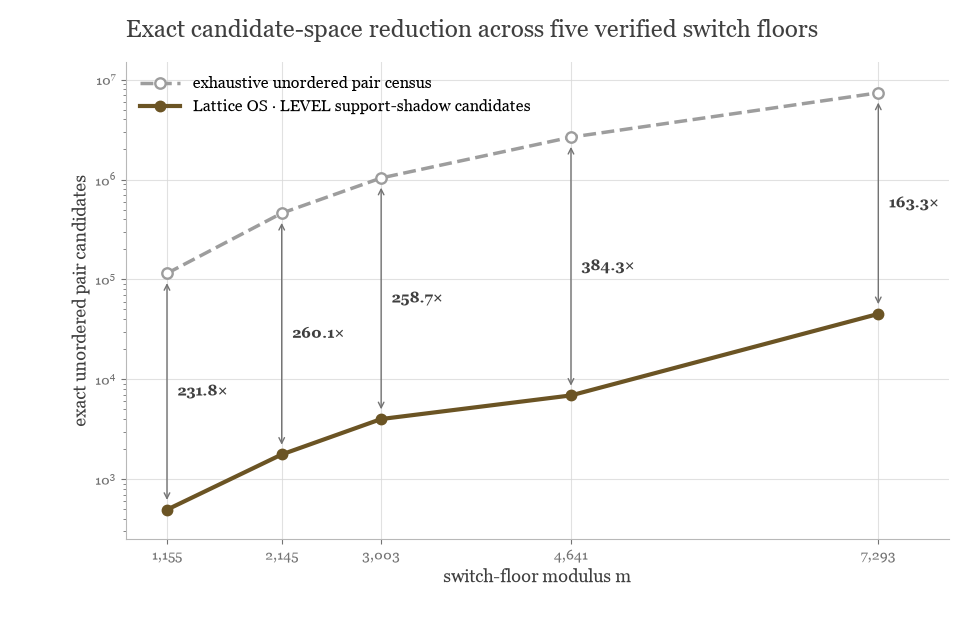
The reduction repeats across five verified switch floors. Against the same-floor exhaustive
unordered-pair census, the LEVEL support-shadow leaves between 163.3× and
384.3× fewer candidates. These are counted candidates, not projected timings.
The room is addressed, not enumerated. Route legality is an exact membership test over
all 12,432,960 well-formed words without requiring their materialization.
The policy pays for itself, countably. The exhaustive divisor census tests
3,108,240 unordered source pairs; restricted to the LEVEL support-shadow it tests
12,015 — an exact ratio of 258.696629…×, a counted reduction and
not an estimate.
The missing coordinate, recovered. Local faces fix each atom's pair by its sum and
product but never say which root continues onto the next fibre. Anchoring the first
non-collision fibre yields an exchange-invariant word that reconstructs the global pair —
all 1,036,080 pairs round-trip.
Checked against an independent path calculation. All 324 glue and clock
representatives agree with both the direct relay and a separately implemented path
computation.
Apples to apples on every floor: all unordered pairs in the exhaustive divisor census
against the exact LEVEL support-shadow candidates presented to the registered route policy. The
reduction is 163.3×–384.3× across five verified floors. It is a deterministic
candidate count, not host timing or projected throughput. The rounded public receipt is
available here.
Exact candidate work — same policy stage, increasing floor
Floor m
Exhaustive unordered pairs
LEVEL support-shadow
Exact reduction
1,155
114,960
496
231.8×
2,145
460,320
1,770
260.1×
3,003
1,036,080
4,005
258.7×
4,641
2,653,056
6,903
384.3×
7,293
7,370,880
45,150
163.3×
Every row is a full certified presentation with zero residual dimension and periodic
re-anchor invariance. This is the work removed before route-policy evaluation. It is not a hardware
runtime or mass-throughput claim.
Secondary route census — exhaustive against policy-restricted
Census
B
C
TEST
Source pairs probed
Exhaustive divisor census
71,280
39,600
32,400
3,108,240
LEVEL support-shadow
218
155
116
12,015
Exact ratio
327×
255×
279×
258.696629…×
Switchyard steel thread — floor m = 3·7·11·13 = 3003; clean-route
counts by class; all 1,036,080 unordered pairs round-tripped; all 324 glue/clock representatives
cross-checked against the direct relay and an independently implemented path calculation. A
demonstration of the exact route-census capability, not a qualified flight or field control system.
How — the membership test, the policy, the glue
Address the room; do not build it. Route legality reduces to an exact
ideal-membership question on the switch floor, so a word is decided in place. The command room is
a coordinate system, not a list.
exact truth test · no materialization
Let the support-shadow cut the census. Restricting the exhaustive divisor
census to the declared LEVEL support-shadow reduces the probe count by a factor you can count in
advance — here 258.7× — because the restriction is arithmetic on the floor, not a
search heuristic.
3,108,240 → 12,015 pairs
Recover the glue the local faces lose. Each atom fixes its pair by
sum and product, which leaves the continuation ambiguous. Anchoring the first non-collision fibre
produces an exchange-invariant word over three letters that, with the local faces, rebuilds the
global unordered pair.
1,036,080 pairs round-trip
Know when not to use it. Unconstrained route existence is Abelian and
belongs to direct CRT construction. The Helix restriction is the right instrument only when the
requested object carries ordered topology, chirality, overlap, or another policy the local faces
do not determine. Physical actuator mapping and joint-card containment stay outside this receipt.
the stated scope boundary