A lunar surface mission has to build on ground nobody can walk out to and inspect. You cannot ship the supercomputer. You cannot send the technician. The surface swings roughly 290 K between a fourteen-day day and a fourteen-day night, and the regolith beneath it is one of the best insulators ever measured. The four questions that decide the build — does the route exist, what does the whole field do, does the heat leave, what is under the site — are precisely the ones that do not survive being sampled, estimated, or run to a residual that merely looks flat.
Selenoform uses the Helix Processor to answer them as exact objects. The route census is a truth test, not a search. The field query returns the complete path-dependent field, not a scalar probe. The thermal schedule is an integer channel count, not a tuned parameter. The subsurface reading comes back with its own integrity band and refuses outside it. One published operator, compiled once, evaluated where re-running the conventional method is physically impossible.
Designed for the Moon, validated on Earth — where you can still go and dig, and where a reader can check the record without taking our word for it. Measured against the fields' own references — a full-field independent calculation, banded and sparse and dense solvers in agreement, public SIT4ME mine-noise records, and exact quorum certificates — and the failures are printed beside the wins. The mathematics is published in full, today, as a single 44-page paper with a DOI. The compiler that runs it is not.
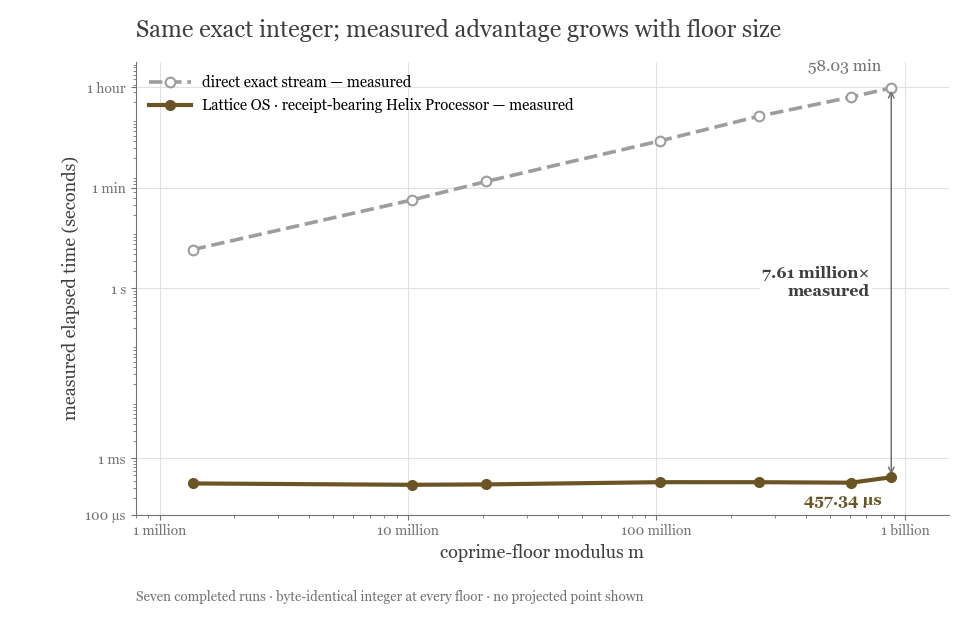
The Helix Processor does not merely run the same calculation faster. Its exact closed form changes how the work grows with the lattice floor. The benchmark below asks both paths for the same exact integer at seven increasing sizes: the direct referee streams the whole floor, while the receipt-bearing Helix path reads the answer from the floor's atoms.
Which sources, ports, and clocks can actually be wired together on a built surface — decided by an exact membership test against your policy, over a command room too large to enumerate.
The complete path-dependent field of a distributed, switched surface — every trajectory, not a sampled few — compiled once and then evaluated at horizons where streaming the answer is no longer possible.
A scheduled, passive thermal valve for a surface that swings hundreds of degrees between day and night — sized by an integer channel count that jitter cannot shift, not by a parameter you tune on site.
A whole-assembly seismic instrument for thin buried structures: pull two acoustic contacts out of one conventional peak, qualify the result on held-out field data, and refuse beyond the measured frontier.
Switchyard, Superhighway, Valve, and Ground are four questions put to one published operator: route the surface, carry the field, keep the heat, listen below. Underneath them sits a conservation law with an unusual property — the complete assembly crystallizes a mode that no coalition below the full assembly can compute. Every part's current is nonzero; they sum to zero. It is conserved by the whole and by no part, and it has no closed form, because the object is not the kind of thing a formula can name. Where a delivered capability rides that mode, it is structurally absent — not hidden, absent — from any incomplete install.
The same substrate carries further confirmed results on this surface, published in the same paper and available on engagement rather than as data sheets:
Selenoform is offered to vetted partners by direct engagement — an instrument pointed at your mission, or the operator pointed at a question of your own. Either way the rule is the same as the rest of Lattice OS: your problem in, the answer out, no copy of your data kept.
Tell us the mission and the answer you cannot go and check. A scoped, direct conversation follows — no tiers, no funnel.