Resolve thin buried contacts in mine noise — then refuse past the measured frontier.
resource-interface super-resolution1,024-address quorum volumeauditable public-noise fixture
Ground is not a collection of independent geophones. The product array is a phased, three-axis volume with 1,024 exact addresses split 341 + 340 + 343. Its selected operating modes belong to the complete worded assembly. The continuum supplies measured pairwise wave responses; the Helix readout supplies the whole-array compatibility law. Removing an axis does not leave a smaller copy of the same instrument.
The product evidence therefore has two separately audited layers. A 48-position public-data fixture tests whether the close-contact read can recover a resource-scale signal from measured mine noise. A second exact architecture receipt tests the 1,024-address quorum census. The fixture is not presented as the product array, and no scale extrapolation joins the two.
Ground resolves acoustic contacts: the top and bottom of a thin, high-contrast body or structure. Seismic contrast can prioritize a resource target; it does not identify elemental composition by itself. Mineral identity remains a corroborating geologic, electromagnetic, geochemical, or drilling result.
THE FIXTURE Three complete field records from the public SIT4ME Sotiel-Elvira mining survey supply the measured receiver geometry and late-time noise. A registered two-contact response is injected at 9 dB full-field SNR. Both readers receive the same 48 positions, eight fixed channels, noise, search interval, and depth grid.
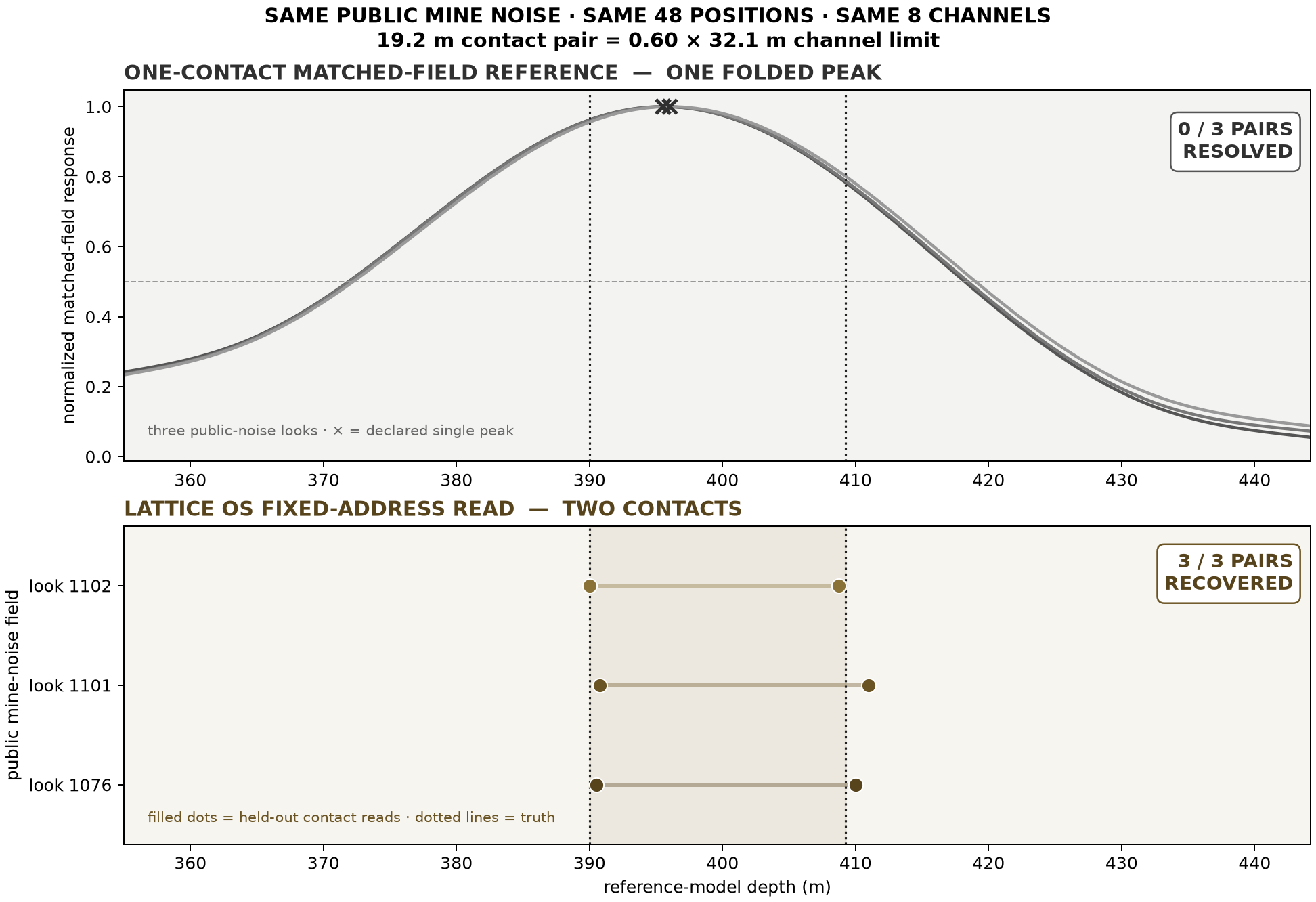
THE RESULT The ordinary one-contact image returns one peak. The fixed-address read returns both contacts and prints where it stops:
Two contacts out of one one-contact reference peak. The registered contacts are 390.00 m and 409.23 m: 19.23 m apart, or 0.60× the 32.05 m limit of the common eight-channel bandwidth. The one-contact matched-field reference returns one peak at 395.5–396.0 m on all three public-noise looks.
Three distinct public-noise recoveries. The held-out fixed-address reads return 390.50/410.00 m, 390.75/411.00 m, and 390.00/408.75 m. Alternating receiver positions are excluded from the fit and used to judge the result.
Noise does not become a resource. With the injected contacts removed, all three measured-noise fields refuse the two-contact model.
The registered benchmark point is tested, not extrapolated. Measured public mine noise is combined with the declared two-contact injection. At 3 dB the read recovers 1/3 looks; at 6 dB, 2/3; at 9 dB, 3/3. Nine decibels is the lowest tested SNR at which every look and every one-class deletion stress passes.
The frontier is on the face. All three looks recover through 0.40× the channel limit. At 0.30× only one survives; by 0.10× all three correctly refuse the two-contact claim.
The upper panel is explicitly a one-contact matched-field reference: three
public-noise looks, one folded peak. It is not an equal-K algorithmic bake-off. The lower panel is
the 48-position readout fixture selecting between pinned K=1 and K=2 hypotheses: two contacts
recovered in all three looks, with half the receiver positions held out of each fit. This chart
demonstrates the readout law; the separately audited 1,024-address quorum receipt establishes the
product architecture. The bridge between those two demonstrations is not yet a fabricated array.
The measured resource-interface result
Test
What was held fixed
Measured result
Common input
48 measured line positions; 8 fixed tones from 11 to 89 Hz; three SIT4ME field-noise looks
same for both readers
Hidden pair
390.00 / 409.23 m; opposite-polarity contacts; declared 5,000 m/s reference conversion
19.23 m = 0.60× limit
One-contact image
complex matched-field profile; half-height and prominence census declared before the read
0/3 pairs; one peak each
Fixed-address read
K=1/K=2 pinned contacts; alternating positions fit / held out
3/3 pairs
Single deletions
8 spatial residue classes and 8 tone channels removed one at a time
16/16 pass all looks
Null field
same measured noise, injected contacts removed
3/3 refuse K=2
Frontier
same 9 dB noise fields; only contact separation changed
3/3 at 0.40×; 0/3 at 0.20×
The 5,000 m/s value converts two-way time to a declared hard-rock reference depth; it is not inferred from the public field records. The exact measured object is the response in the registered moveout model. This is a semi-synthetic signal-injection benchmark in measured mine noise, not a claim that the raw public survey has been reinterpreted to localize its known ore body.
The array is the mode, not the elements
Quorum object
Exact result
Meaning
Physical addresses
1,024 = 341 + 340 + 343
three phased axis words
Latent volume
706,814,760,960 sites
compiled; not enumerated as receiver verdicts
Dense representation avoided
3.596×1024 operator entries
entry count, not a projected runtime
Operating band
13 families / 40,338,372 modes
100% word-born in the complete assembly
Protected content
39,331,004 modes
exact inclusion–exclusion across all axis subsets
Failure language
deletion −290; class flip −1,028
absence and mistuning are different mode-census signatures
Proper-axis assemblies retain other kernel content; they do not retain the selected word-born operating band. “Below quorum” therefore means the product observable is structurally absent, not that every subset matrix has zero nullity. Passive free-space coupling remains pairwise. The quorum lives in the phased arithmetic readout.
Audit both layers: resource-interface fixture JSON —
public byte ranges and hashes, receiver and tone Address Books, all readings, SNR census, deletion tests, frontier, refusals, and scope. Deterministic payload audit:
de9e0e421e1d1f194fbac5dd583359cc7f64ef9554f9c51e9310cd79466e208c; downloadable-file SHA-256:
8c8403c5ba861c0be4d5d2328369a9f4122f70c07a9a9f9aaef48d0199ef084c. quorum architecture JSON —
axis construction, subset counts, inclusion–exclusion, operating-mode closure, fault channels, and boundary. Deterministic payload audit:
87a1cd2837a3560883ef64121e5282f248b0b4319b6e0fa2d56b5185cb92982f; downloadable-file SHA-256:
e0a8f5dfe0c12718444f40817ccd8be4e6b242d1a2f0dc6f2f88916ed3ec35d3.
How Ground is used
Construct the Address Book for the survey geometry. Public receiver identifiers are not treated as positions. The fixture maps the unit residues to measured arc length; the product compiles three phased axis words into one volume.
geometry first · exact addresses · no rectangular fiction
Read the full complex field. Ground preserves phase and polarity across the fixed channel book. A thin body is a coupled two-contact hypothesis, not two unrelated scalar detections.
full field · opposite-polarity contacts
Fit locally; judge on data that did not fit. Alternating positions estimate K=1 or K=2. The excluded positions must independently reduce the residual before the second contact is accepted.
transport holdout · no success-only read
Return a target interval or refuse. The output is a qualified acoustic contact interval with its receipt and boundary. It is not a mineral assay, and a coherent noise field is not promoted into a two-contact target.
interval + status + evidence
Published mathematics and public referees
The novel claim is not that seismic reflection, matched-field imaging, the bandwidth limit, coprime sampling, or VMS exploration exists. Ground composes a fixed integer Address Book, a whole-assembly mode census, a pinned close-contact read, held-out transport, and explicit refusal. The public fixture is auditable from its JSON; a qualified reviewer can request the bounded reference implementation without receiving the private compiler.
Helix, quorum conservation, sparse sensing, and claim boundaries. A. P. Matos, The Helix Operator: The Exact Integer Helix on the Coprime Substrate, especially §§11.6 and 13.3.3, DOI 10.5281/zenodo.21611872.
Public mine-noise and geometry source. J. Alcalde, D. Martí, R. Carbonell et al., SIT4ME: Innovative seismic imaging techniques for mining exploration — Sotiel-Elvira (Spain), DOI 10.20350/digitalCSIC/8633, CC BY 4.0.
Public seismic repository context. D. Martí et al., “Reassessing the lithosphere: SeisDARE, an open-access seismic data repository,” Earth System Science Data 13 (2021) 1053–1071, DOI 10.5194/essd-13-1053-2021.
VMS seismic imaging precedent and physical contrast. G. A. Donoso et al., “3D reflection seismic imaging of volcanogenic massive sulphides at Neves-Corvo, Portugal,” Geophysical Prospecting 71 (2023), DOI 10.1111/1365-2478.13269.
Coprime-array prior art. P. P. Vaidyanathan and P. Pal, “Sparse sensing with co-prime samplers and arrays,” IEEE Transactions on Signal Processing 59 (2011) 573–586, DOI 10.1109/TSP.2010.2089682.
Classical resolution referee. Lord Rayleigh, “Investigations in optics, with special reference to the spectroscope,” Philosophical Magazine 8 (1879) 261–274, DOI 10.1080/14786447908639684.